Tuesday, 13 September 2011

Federer/Djokovic/Nadal - The rivalry and the 7th house

I've been watching these three players this year and what seems interesting is how they play against each other. Djokovic is the indisputable No 1 and he has had an amazing year. However, he seems to have a harder time beating Federer than he has beating Nadal. Federer himself seems more at ease playing the "unbeatable" Djokovic, whereas when he faces Nadal, he feels weak at the knees. 

Of course, one can argue that it's the kind of game each one plays, which could be more suited to playing a particular opponent. But when you become No 1, and all of these players have reached that point at some stage, this means you are able to beat anybody.

 Can astrology shed some light into this? Unfortunately, Djokovic's chart in the astrodata bank has a C rating, so we will have to make do with the charts of the other two.

Astrologically, this is a 1st/7th house matter. As I see it, when a player walks into the court, he becomes his 1st house and the opponent his 7th house. So, what happens to these players' 7th house when they play against each other? 

Federer has a Virgo Ascendant and a Pisces 7th house. Djokovic, unless the birth time we have is terribly wrong, has the Moon in Pisces. This Moon is waxing, has very little little light and it's peregrine. It is not received by its sign ruler (Jupiter doesn't aspect it), but, fortunately, is in a mutual reception by exaltation with an extraordinarily dignified Venus in Taurus. This helps a lot. Djokovic's Jupiter, the ruler of Pisces, is also peregrine in Aries, but it's in a mutual reception with Mars in Cancer, the sign of its fall. So for Federer, when he plays Djokovic, Jupiter isn't much of a problem, but he looks directly at the Moon in Pisces in his 7th house, which, by itself is not a dangerous opponent, but can become extremely dangerous when Venus steps in. All in all, Federer may regard Djokovic as a worthy opponent, but he is not in awe of him.

However, when he plays Nadal, it's a completely different story. Federer looks across the court and what does he see? He sees Jupiter in Pisces (Nadal's natal placement)! So, when he plays Nadal, he feels he is playing against the king and most of the time all he can do is bow at his greatness.

Now, what happens when Nadal plays Djokovic? Nadal (Scorpio Ascendant, Taurus 7th house) looks across the court and sees an extremely powerful Venus in Taurus! He just cannot believe he can beat him.

Naturally, this doesn't mean than any player with Venus in Taurus can beat Nadal or any player with Jupiter in Pisces can beat Federer. That would be absurd. Even if the, let's say, No 500 ranked player in the world has Jupiter in Pisces and may even at some point snatch a victory from Federer, there's such a difference in the quality of their games that the low ranked player cannot expect anything more. But we are talking here about top players who are at the same level and who wins each time is not determined by how good they are, but how they feel towards one another.

Nor does this mean that Nadal will always beat Federer or Djokovic will always beat Nadal. They seem, however, to have the upper hand, now that they've all reached the same level.

Wednesday, 31 August 2011

More on temperament

One important element of temperament assessment is the Moon, both by phase and by sign. There seems to be a disagreement among various authors as to whether these two factors, Moon phase and Moon sign, should be judged separately or not. Frawley gives predominance to the Moon phase while the Moon sign, whatever it is, cannot alter this basic temperament, he says, just mitigate it. Dorian Greenbaum judges these two factors separately, but gives 1 point to the Moon phase and 2 points to the Moon’s sign. She also takes into account the Moon Ruler, giving it 1 point. Even though I’m not yet convinced about which is the right way of assessing the temperament, I believe - for the moment at least – that the Moon phase is more important than the sign and I agree with Frawley’s method.

However, there is a problem. The real temperament of each of the Moon’s phases is not exactly what the books say. After the New Moon, the Moon is becoming increasingly hot and is gradually losing moisture. But we cannot possibly call a Moon, which is a few degrees ahead of the Sun, hot and moist. Moist yes, but hot? It has practically no light, so it is still very cold. As it moves, it is indeed gaining in heat, but it is by no means hot. All the possible Moon placements between the New Moon and the Full Moon are deemed hot, but there’s a vast difference in heat between a Moon just a couple of degrees after the New Moon and a Moon a couple of degrees before the Full Moon, isn’t there?

What seems even more absurd is to call the Moon a couple of degrees after the Full Moon cold and the Moon just after the New Moon hot, when it is really the other way around. True, the fact that the phase changes can be important in the sense that the Moon before the Full Moon is still, let’s say, optimistic while after the Full Moon there is a tendency to melancholy, since there's nothing to look forward to, but this Moon still has enough heat to fight away coldness.

I feel we need to be more precise and flexible when it comes to assessing the Moon’s temperament and take into account the exact distance of the Sun and judge accordingly. Take a Leo Moon, for example, a few degrees after the Full Moon. We would judge this as a moderately cold and very dry Moon, when in fact it is a very hot Moon, isn't it?

Monday, 29 August 2011

The Moon as Mind

In John Frawley’s book, the Real Astrology Applied, there is an interesting article (the Moon as Mind) about the role the Moon plays in determining the nature of the native’s mind. It is not Mercury, Frawley says, the important factor when it comes to mind, because Mercury is a servant and has no morality. If we give Mercury free rein, then we will have no sense of right and wrong and knowledge without morality is no true knowledge. The Sun is “knowledge”, the Moon “intuits” knowledge and Mercury’s role is simply to apply it. Frawley feels that this is the right way to view things, but after the Renaissance, that view was lost and Mercury, the servant, became king.

I feel that Frawley, in this article, by siding completely with the Moon, he underestimates Mercury. It is understandable, since he is a traditional astrologer, to want things to return to the way they were and his efforts to reinsert traditional mentality in the modern view of the cosmos is commendable, given the fact that it was completely put aside by the moderns and any link to tradition is nowadays considered a stupidity, as something obsolete. However, there must be an explanation for this sudden shift in mentality, mustn't it?

The real question, to my mind, is why did this adulation of Mercury actually take place? If everything was going well and the Moon’s view was correct, why was there a need for this radical shift in mentality? Why did Mercury completely take over? Could it be that the Moon, left to her own devices, led to extremes?

If one believes in the concept of the astrological ages, we are on the brink of leaving the age of Pisces and enter the age of Aquarius. This means that we were all experiencing the Jupiter/Mercury polarity (Ascendant/Descendant of the age). Some authors say that it is the Ascendant that lays the rules, but there needs to be a fine balance between Ascendant and Descendant, otherwise the Descendant part of the polarity will rebel, if repressed continuously for a significant amount of time. Jupiter, after some point, was completely out of control and Mercury naturally stepped in.

Jupiter is of course the arch-enemy of Mercury and represents intuitive knowledge. That’s why it rules religion and faith, because faith doesn’t require proof for it to exist. Strongly jupiterian people KNOW that there is a God or whatever else they really believe in and it doesn’t matter to them whether they can prove it or not. They just KNOW. Jupiter is very friendly with the Moon (the Moon exalts Jupiter in her sign) and the Moon shares Jupiter’s mentality. Jupiter, however, is the “fanatic”. One goes to a Catholic monastery and has an epiphany and then the Jupiter/Moon duo makes him say: “Oh my God! This religion business is true! I will become a Catholic!” But if he stopped to think and studied religion objectively, he would realize that all religions have stories of the same nature and these are not - by any means whatsoever - the exclusive privilege of Catholicism.

Mercury, on the other hand, asks the basic question. Do you believe that God exists? OK, prove it to me. If something cannot be proven, I cannot believe in it. Why is this useful? Because it can offer us absolute truths. Anything that is proven can be relied upon. It’s not the chaos of “I think this, you think that” and so on. This knowledge is stable and secure. Granted, it is indeed restrictive, because it allows no room for things that have not been proven yet to exist. But what about the Moon? Can it be equally restrictive?

The Moon’s knowledge comes through experience. The Moon rejoices in the 3rd house of everyday activity and it is the fastest moving planet. It experiences life and offers that knowledge to the Sun. Experience, however, is overrated. True, you may know something theoretically, but only when you actually experience it can you truly understand it. But this “understanding” is your interpretation. It’s not valid for everybody and therefore the Moon’s knowledge is subjective. The Moon says “Because I’ve experienced so and so in such and such a way, then it is the rule”. No, it isn’t.

Take temperament, for example. A strongly choleric person not only believes that acting upon things is the right way to go through life, but this is actually their own personal experience. When they don’t “do”, nothing happens. So, how can you possibly convince them that inertia is not such a bad thing? A phlegmatic, however, responds: “Yes, not many things happen to me because I prefer idleness, but by a magic twist of fate, the few things that actually matter do happen regardless of whether I do something or not. If I live in constant activity, these important things may pass me by, because I will be too busy to pay any attention.” This is their personal experience. Who is right and who is wrong? They are both right, aren’t they?

This Moon mentality (no proof needed) is mostly evident in traditional books on astrology with all these aphorisms. If so and so is in the 12th house and aspects so and so in the 8th house, then you will be eaten by wild beasts. Today we laugh at remarks like that and quite rightly so, but it shows the mentality of the astrologers at the time. This was based on the chart of one particular client, but it was foolishly made a rule. The Mercury element was completely absent. Mercury says: “First, test this rigorously and only when it has proven its validity, put that in a book”.

The Moon therefore is dangerously subjective. Do we want objectivity or don’t we? Mercury is not immoral, but amoral. It may be dangerous to live without morals, but morality, whether we like it or not, clouds the thinking process. Frawley cites the computer as an example to show Mercury's lack of morality. The computer doesn’t judge, he says, it processes whatever data you put into it. True, but why is this a bad thing? If I impose my morals or the current morals on knowledge, I may refrain from studying something because it doesn’t agree with them. Morals, however, are prone to change. Is it wise to base knowledge on them?

Frawley also says that Mercury needs to be disciplined. But Mercury is not averse to discipline, Mercury is not an enemy of Saturn. It is the Moon that hates discipline because it is the Moon that receives Saturn in detriment in her own sign.

In conclusion, I don’t believe that this is a question of either/or. Frawley himself agrees on that when he says that in astrology for example we need Mercury - the tools (charts etc.) - to interpret the cosmos, but I believe he favours the Moon too strongly. If we are to eventually reach the truth, both Mercury and the Moon need to be functioning well and none of the two must ever take complete charge. They are equally important. Mercury cannot perceive intangible reality, but the Moon cannot be relied upon to interpret it. It’s a 50-50 process.

Sunday, 21 August 2011

Outer planets and temperament

Assessing the temperament is not as easy as some authorities would have you believe. The mere fact that there is so much disagreement over the correct way of assessing it proves my point. We may easily discard the modern method -which simply takes into account the signs the planets are in - as general and vague, but it seems that traditional astrologers as well cannot agree on which chart factors are important for the correct assessment. In Dorian Greenbaum's book on temperament, all the various methods that have been proposed over the years are presented and she comes up with her own method, which is in many ways different than the ones presented. John Frawley has also his own method. The problem is which chart factors should be included and - even more importantly - how.
Let me complicate things a bit further. What about the outer planets? It is my belief that although outer planets are overrated in modern astrology, they are underrated in traditional astrology. I wholeheartedly agree on the fact that they don't rule signs, but that doesn't make them unimportant. They are simply different than the other planets in the sense that they are not affected by the sign they are in. They are beyond signs. It is the sign and the area of life that is associated with it that is going to be affected, not the other way round.
So should we include them in the assessment of temperament? My answer is yes, I don't think it's safe to completely ignore them. We need to be careful, though. If they are closely conjunct the angles or form tight aspects - the strong ones (conjunction, opposition, square) with the Lights or the ruler of the Ascendant, I think it's best to include them.
But then, what is their temperament? Since they are in a class of their own, they must have a natural temperament regardless of the sign they are in or whether they are oriental or occidental of the Sun.
I think there can't be any doubt that Neptune is by nature extremely cold and extremely moist. It is the planet of hypersensitivity, of great emotionality, of inertia and apathy and of very low energy levels. Uranus is indeed very individualistic (which means that it can't possibly rule Aquarius) and likes to break rules, but unlike Aquarius doesn't want to replace them with new ones. He is interested in chaos and anarchy and likes to cause havoc whenever he can. I think this makes him hot and dry.
Finally, with Pluto we have the same problem as Mars, which is a hot and dry planet but a nocturnal one that rules the water triplicity. It is the Scorpio problem, a cold and moist sign ruled by a hot and dry planet, Mars. Pluto is a planet that can cause great emotional turmoil, but with hot and dry action. It doesn't connect, but separates things, it eliminates all the things that threaten survival and very often with extreme brutality. A Pluto period is almost invariably a period of very high adrenalin levels, of extreme alertness and cautiousness. I think this classifies Pluto as a hot and dry planet.
Tell me what you think.

Friday, 19 August 2011

Sect

What is sect? Sect is a sort of planetary dignity based on the notions of “diurnal” and “nocturnal”. We have diurnal charts, meaning the birth took place during daytime (the Sun is placed above the horizon, in houses 12th, 11th , 10th ….7th) and nocturnal charts, meaning the birth took place during nighttime (the Sun is placed below the horizon, in houses 1st, 2nd, 3rd ….6th). In diurnal charts the Sun is called the luminary of sect and in nocturnal charts the luminary of sect is the Moon. In traditional astrology the Sun and the Moon were awarded equal power and whether you were born during the day or at night, your affinity lies with the corresponding Light.

Planets are by nature diurnal or nocturnal as well. The Sun, Jupiter and Saturn are diurnal while Mars, Venus and the Moon are nocturnal. Mercury is neither diurnal nor nocturnal. Some authorities say that Mercury is diurnal when oriental (rising ahead of the Sun) and nocturnal when occidental (setting after the Sun). Notice that Saturn, the planet of darkness is thought to be a diurnal planet, while Mars, a fiery planet, is thought to be nocturnal. This is so, because it was believed that Mars and Saturn (the natural malefics) when found in the opposite sect of their nature, lose some of their malefic qualities.

Planets are also diurnally or nocturnally placed. A planet is diurnally placed when it is situated on the same side of the Sun (where the light is) and nocturnally placed when it is situated on the opposite side of the Sun.

Finally, the signs themselves are either diurnal or nocturnal. The masculine signs are diurnal (Aries, Gemini, Leo, Libra, Sagittarius, Aquarius) and the feminine signs (Taurus, Cancer, Virgo, Scorpio, Capricorn, Pisces) are nocturnal.

If a planet has all of the above (e.g. a diurnal planet in a diurnal chart, diurnally placed in a diurnal sign) is said to be in hayz (completely in sect) and the planet is strengthened a lot. But what sort of strength, what sort of dignity?

As I see it, sect is a sort of accidental dignity. An essentially debilitated planet (Mars in Libra, for example) doesn’t gain in quality (essential dignity) when in sect, but it gains in accidental dignity, that is it has more power to act. A planet in a cadent house, for example, if in hayz, gets back some of the accidental dignity that it lost by being cadent. It becomes more powerful, but not better.

Let’s take Amy Winehouse’s Moon, for example (you can find the chart in the post below). We have a nocturnal chart (Sun below the horizon), the Moon is a nocturnal planet by nature, it is nocturnally placed (on the opposite side of the Sun) in a nocturnal sign. It is, therefore, completely in sect, in hayz and becomes accidentally dignified, even though it’s in the 8th house, a debilitated placement. Capricorn, however, is the sign of the Moon’s detriment, so what do we end up with? We have a powerful planet prone to bad behaviour. Had it not been in sect, it wouldn’t have had much power and its effects on Amy’s personality would have been less obvious.

Sect can also be used to explain why planets seem to behave quite well despite their severe accidental debility. Roger Federer and Madonna for example have 12th house Suns in Leo. Their Suns are essentially dignified by being in Leo, the sign the Sun rules, but apparently have no power to act, by being in the 12th house. These Suns, however, are in hayz and this could decrease their accidental debility.

Saturday, 23 July 2011

Amy Winehouse dies

I found this chart for Amy on the London School of Astrology facebook page. It seems to work well.

We already knew about the applying Sun/Neptune and Mercury/Neptune squares, to which many of her substance abuse problems have been attributed, but using this birth time Mercury becomes the Ascendant ruler, which makes it doubly important. Furthermore, the Moon becomes the luminary of sect (also doubly important) in the sign of its detriment (Capricorn) and conjunct the 8th house cusp. Not a very good sign.

Let's move to progressions. The secondary progressed Moon has just completed its first (around 28 years) cycle and has returned to its natal place and at the time of death it is found immediately after the natal 8th house cusp. The solar arc progressed Moon (still in Capricorn) is in a partile square with Pluto.

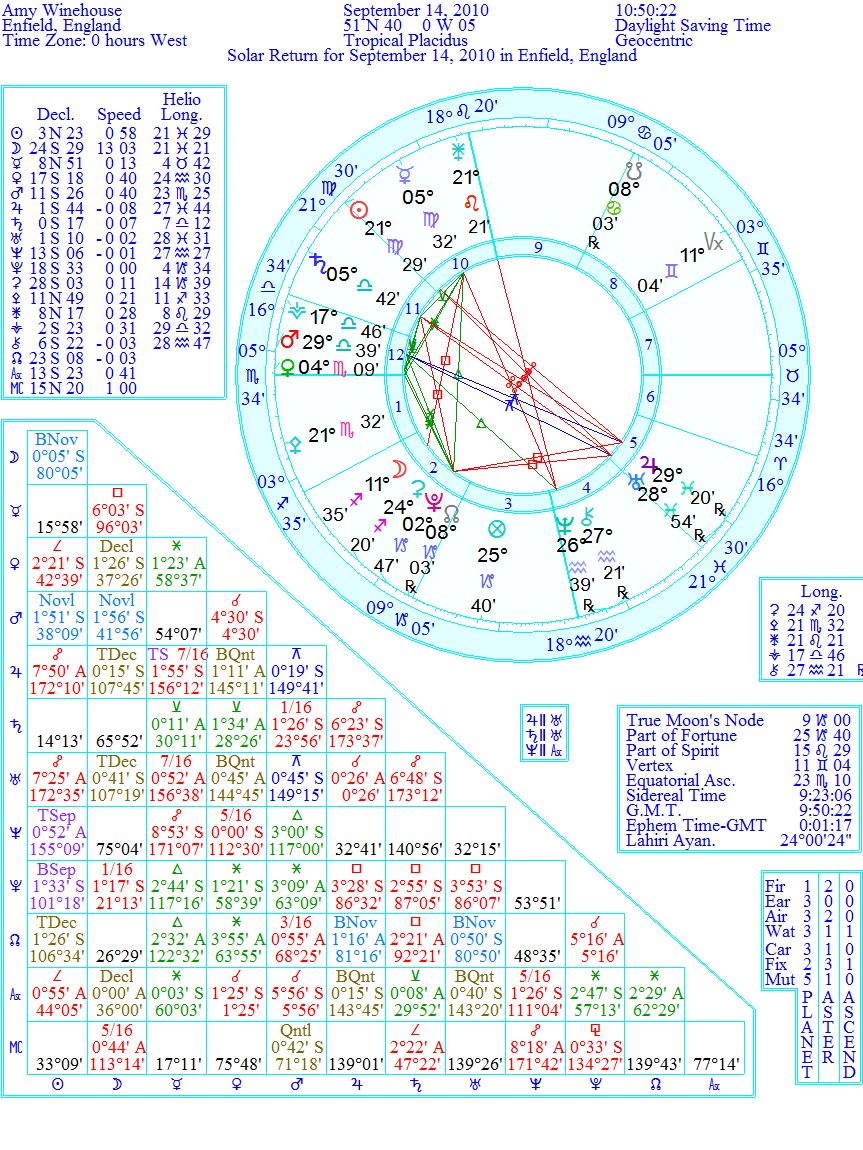
The solar return chart and especially the lunar return chart are even more astonishing. This is the solar return chart.

The SR Ascendant ruler is Mars in its detriment in the 12th house of self-undoing and self-destructive tendencies and, what's more, the 12th house ruler (Venus) is also in its detriment right on the Ascendant! We have a negative mutual reception between Mars and Venus this year, which tells us that 12th house issues are going to be a focus area and probably it won't work out well for her. Moreover, the natal Ascendant (Gemini) falls in the SR 8th house.

The same pattern is repeated in this month's lunar return.


We -again - have Scorpio rising and Gemini (the natal Ascendant sign) on the 8th house cusp, exactly like the solar return chart. But in this chart the ruler of the Ascendant (Mars) is exactly conjunct the 8th house cusp!!! A most dangerous month for her.

Rest in peace, Amy.

Saturday, 4 June 2011

Horary astrology - Federer vs Djokovic


I cast this chart before yesterday's semi-final at the French Open, but it seemed too good to be true. The chart gave such an obvious advantage to Federer that I felt it couldn't possibly reflect reality, since Djokovic, up until yesterday, had been enjoying a streak of 41 consecutive wins, having already beaten Federer three times and Nadal, world No 1, four times. On the other hand, Federer this year has dropped to No 3 in the world rankings and didn't seem capable of posing a threat for either Djokovic or Nadal. The chart, however, said otherwise.
Since I support Federer, he gets the 1st house and Djokovic the 7th. Therefore, Federer is Mercury (ruler of the 1st house) and Djokovic is Jupiter (ruler of the 7th). Federer is exactly conjunct the Midheaven, while Djokovic is on the cusp of the 9th house, a cadent one. Following the Frawley method, in this type of charts, it is accidental dignity that counts the most and in this case, the difference between the two is striking. Federer must win.
And so it proved.